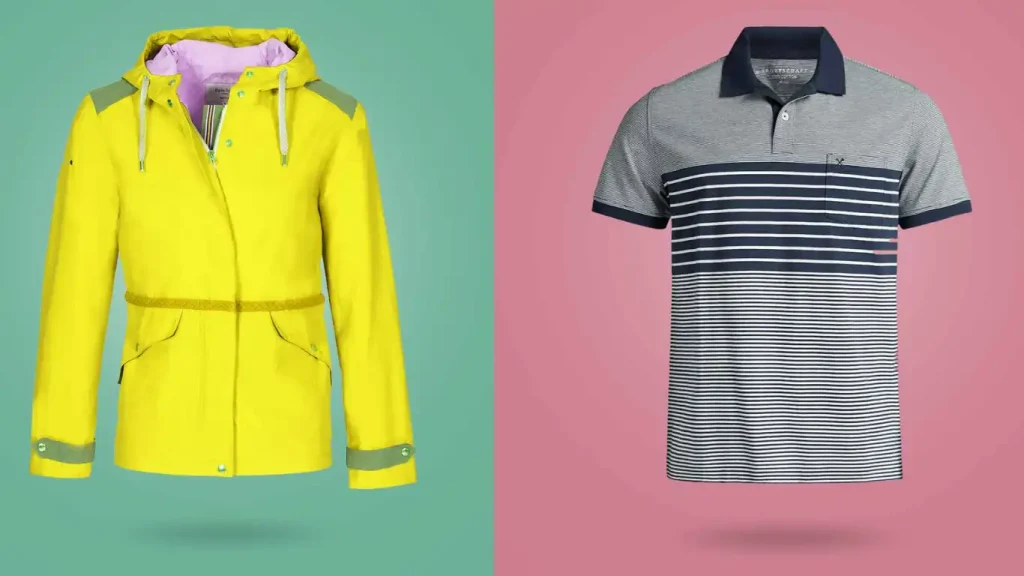
Textile image standardization is no longer optional for brands competing in digital-first markets. Whether you are supplying fabric swatches to a B2B buyer portal, uploading apparel to an Amazon storefront, or presenting a seasonal lookbook, inconsistent product imagery directly damages conversion rates and supplier trust.
The global digital textile printing market – valued at approximately $5.8 billion in 2024 and projected to reach $11.6 billion by 2030 at a 12.7% CAGR – has pushed image consistency to the center of digital operations. Every stakeholder in that supply chain, from fabric mills to eCommerce brands, needs standardized visual assets that accurately represent drape, texture, color, and sheen across every platform and device.
This guide covers the leading tools across three functional tiers: AI-powered catalog automation, spectral color management, and 3D fabric digitization software.
Why Textile Image Standardization Is So Difficult
Textiles present unique imaging challenges that standard product photography workflows are not built to handle. Unlike hard goods, fabric introduces:
- Surface reflectance variation – the same fabric photographed under different lighting temperatures reads as a different product
- Texture depth and pile height – velvet, corduroy, and terry cloth require completely different shadow and highlight treatment
- Drape and form – flat-lay images of woven fabrics rarely communicate how a garment hangs on a body
- Dye lot inconsistency – the same colorway dyed across different production runs can differ by more than 1.0 ΔE (Delta E), exceeding acceptable retail tolerances
Solving these variables requires purpose-built tools, not general photo editing software.
Category 1: AI-Powered Image Standardization and eCommerce Catalog Tools
These platforms use machine learning to automate the most time-consuming parts of textile image post-production: background removal, texture normalization, upscaling, and ghost mannequin effects.
Claid.ai

Claid.ai is an enterprise-grade image enhancement API used heavily in high-volume eCommerce operations. Its core capabilities for textile workflows include automated background normalization, AI-powered image upscaling (up to 4× resolution enhancement), and real-texture adjustment that accounts for fabric surface characteristics. Brands processing tens of thousands of SKUs per month use Claid as an automated pipeline rather than a manual editing step – significantly reducing per-image cost and processing time at scale.
Textile Designer AI
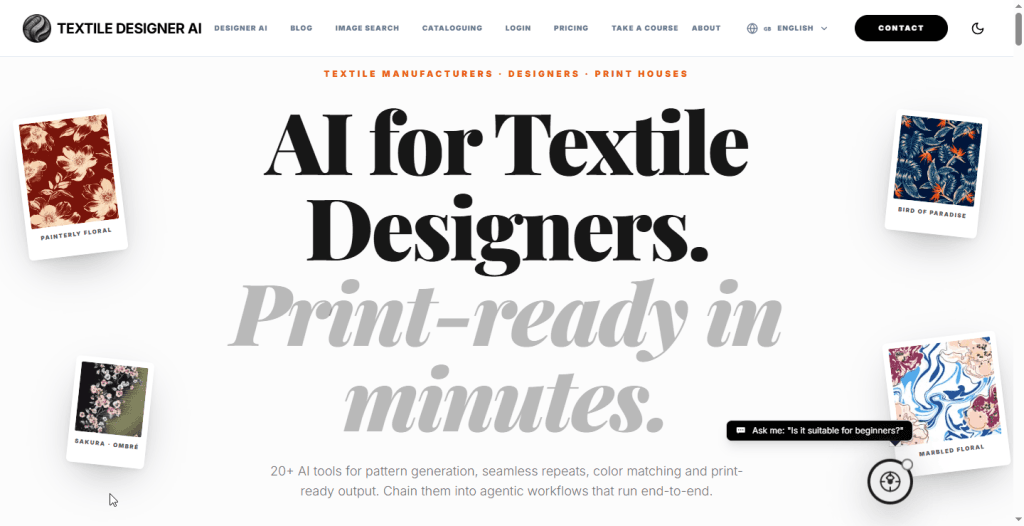
Built specifically for textile manufacturers and print-on-demand brands, Textile Designer AI handles the upstream side of image standardization: it automates color layer separation for screen and rotary printing workflows, generates seamless repeat tile patterns from scanned fabric motifs, and applies Anti-Blur algorithms to clean raw scanner output into production-ready digital files. This positions it primarily as a pre-production tool rather than a catalog-facing one.
Professional Retouching Services (Human + AI Hybrid)
For apparel brands that cannot afford for standardization errors to reach live listings, outsourced professional retouching services remain the most reliable solution. These services combine AI automation with skilled retoucher review, covering ghost mannequin and neck joint effects, multi-clipping path isolation for component-level color variants, and platform-specific output formatting for Amazon, Shopify, and eBay compliance requirements.
Category 2: Spectral Color Management Software and Hardware
Color accuracy in textiles cannot be evaluated on a monitor. The human eye and standard display calibration cannot replicate how a fabric dye absorbs and reflects wavelengths across different light sources – a problem known as metamerism. Spectral color management tools solve this by measuring and communicating color as objective numeric data rather than visual approximation.
X-Rite Textile Color Suite
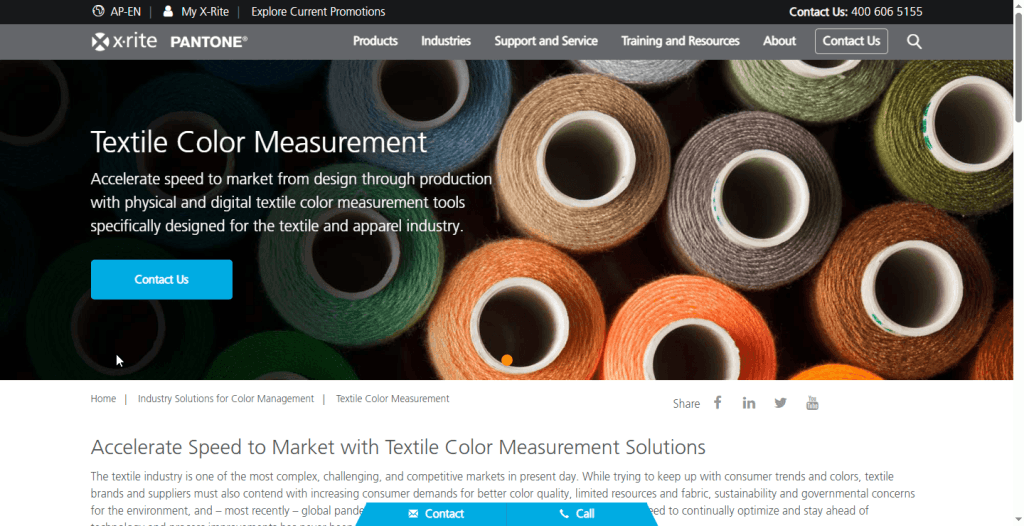
X-Rite has over 60 years of innovation in color measurement and is considered the primary reference standard for industrial color management across textiles, automotive, coatings, and packaging. For textile-specific workflows, its key instruments include:
- Ci7860 Benchtop Sphere Spectrophotometer – delivers specifications 25% tighter than comparable industrial instruments; used for digital color standard creation across textile supply chains
- MetaVue VS3200 Imaging Spectrophotometer – a non-contact 45:0 geometry instrument designed specifically for measuring multi-colored and patterned fabric samples
- Textile Color Hub – a cloud platform that enables brands to communicate color standards digitally without shipping physical samples; X-Rite reports that this system helps suppliers achieve 95% of lab dips correct on the first attempt, reducing time-to-market by 75%
- Color iQC – quality control software that maintains color consistency throughout the supply chain by comparing measured fabric values against approved digital standards
X-Rite instruments comply with ISO, CIE, ASTM, and DIN color measurement standards, which is critical for international supplier qualification programs.
Datacolor Spectro Series
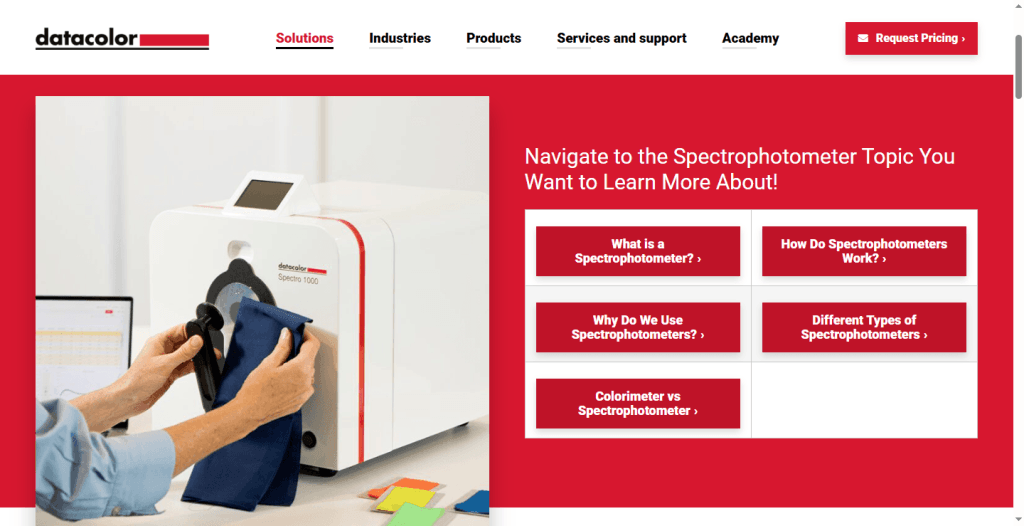
Datacolor is X-Rite’s direct competitor and is equally regarded in textile dye labs and garment quality control operations. Its Spectro 1000 is positioned as a reference-grade instrument, offering high-speed measurement, tight Inter-Instrument Agreement (IIA), and seamless integration with Match Textile formulation software – a widely used tool for dye recipe matching in mill environments. Datacolor also offers the more accessible Spectro 700 for growing labs and supplier-side quality programs, providing sphere geometry and UV control at a lower price point without sacrificing core accuracy. Together, X-Rite and Datacolor define the instrument-based color management landscape for professional textile imaging.
Category 3: 3D Fabric Digitization and Simulation Software
As fashion brands accelerate toward digital-first product development, 3D fabric simulation software has become the primary method for creating standardized visual assets from physical textile data – bypassing the need for physical samples entirely at early design stages.
CLO 3D and the CLO zFab Kit

CLO Virtual Fashion is one of the most widely adopted 3D garment design platforms in the industry, with over two decades of research and development in accurate garment simulation. Its ecosystem spans designers, small businesses, and major apparel brands globally.
In July 2025, CLO launched the CLO zFab Kit – an AI-powered fabric digitization hardware system comprising three devices: the zFab Cutter, zFab Draper, and zFab Scanner. Together, these tools capture a fabric’s physical attributes (weight, drape, stiffness, surface reflectance) and convert them into high-fidelity digital representations that behave accurately in 3D simulation under standardized D65 studio lighting parameters. The system is designed to dramatically reduce manual measurement errors and dramatically accelerate the digitization pipeline for brands, vendors, and fabric mills.
CLO’s broader product ecosystem also includes CLO-SET for digital collaboration and CONNECT for digital fabric trading, making it a comprehensive infrastructure solution rather than a standalone tool.
Browzwear
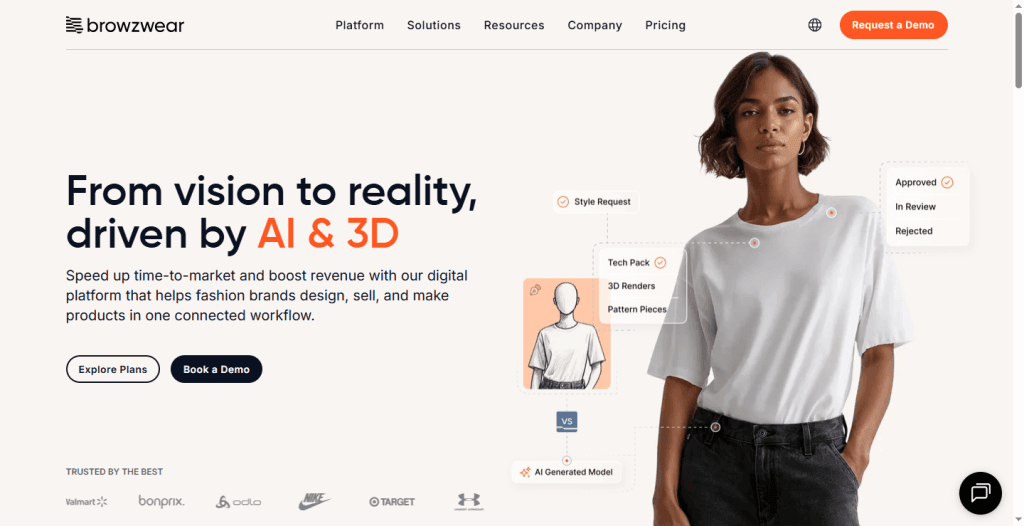
Browzwear is CLO’s closest competitor in the enterprise 3D garment space. It is used by major fashion brands and manufacturers for photorealistic 3D visualization, virtual fit testing, and standardized fabric presentation under controlled lighting. Like CLO, it allows brands to create catalog-ready renders from digital fabric data – eliminating the inconsistency introduced by physical photoshoots.
Style3D AI

Style3D AI is a newer entrant that has gained rapid traction for its AI-enhanced fabric physics engine, which computes drape, weight, and light reflectance properties from 2D sketch or scan input. It is particularly used in markets where turnaround speed and cost efficiency are prioritized alongside visual accuracy.
The 3D Fashion Design Software Market overall is projected to grow at a 5.92% CAGR from 2025 to 2035, with key players including CLO Virtual Fashion, Browzwear, Style3D, Optitex, and Lectra.
Choosing the Right Tool for Your Workflow
| Workflow Stage | Recommended Tool Category | Primary Output |
| Raw scan clean-up / pattern repeats | Textile Designer AI | Production-ready print files |
| High-volume catalog image processing | Claid.ai / Professional retouching | Platform-optimized product images |
| Ghost mannequin and neck joint | Professional retouching service | Apparel catalog images |
| Supply chain color communication | X-Rite Textile Color Hub | Digital color standards (CxF format) |
| Dye lab quality control | X-Rite Ci7860 / Datacolor Spectro 1000 | Spectral measurement data |
| Virtual sample creation | CLO 3D + zFab Kit | 3D garment renders |
| Photorealistic catalog renders | CLO 3D / Browzwear | Standardized marketing visuals |
The Role of Professional Retouching in Textile Image Standardization
Even with AI automation and 3D simulation, brands selling physical apparel on Amazon, Shopify, and other marketplace platforms still require post-production retouching to meet platform-specific image requirements. Ghost mannequin effects, color variant isolation using multi-clipping paths, background normalization to pure white (#FFFFFF), and shadow rendering to simulate fabric weight are all production steps that automated tools cannot fully replace – particularly for complex garments with multiple layers, textures, or structural details.
This is where outsourced retouching service workflows offer a practical advantage: consistent output standards, platform compliance, and the flexibility to handle edge cases that AI pipelines reject.
Conclusion
Standardizing textile images in 2026 requires a stack of complementary tools rather than a single solution. Spectrophotometers and color management software solve the color accuracy problem at the supply chain level. AI catalog platforms solve throughput and background consistency at scale. 3D digitization platforms eliminate physical sample dependency for early-stage design. And professional retouching services bridge the gap between automated output and marketplace-ready compliance.
Understanding which tool addresses which bottleneck – and how they interconnect – is the starting point for building a scalable textile imaging workflow.