If you’ve recently bought an APS-C camera, you might have noticed that your photos look a bit more “zoomed in” than you expected. You aren’t imagining things. This phenomenon boils down to a fundamental photography concept: the crop factor.
Whether you are shooting wildlife with a telephoto lens or trying to capture sweeping landscapes, understanding how your APS-C sensor alters your lens’s focal length is crucial for getting the shot you want. Let’s break down exactly what crop factor is, how to calculate your effective field of view, and what it means for your photography.
What Exactly is an APS-C Sensor and Crop Factor?
To understand crop factor, we first have to look at the gold standard of digital camera sensors: Full-Frame. A full-frame sensor is the same physical size as traditional 35mm film.
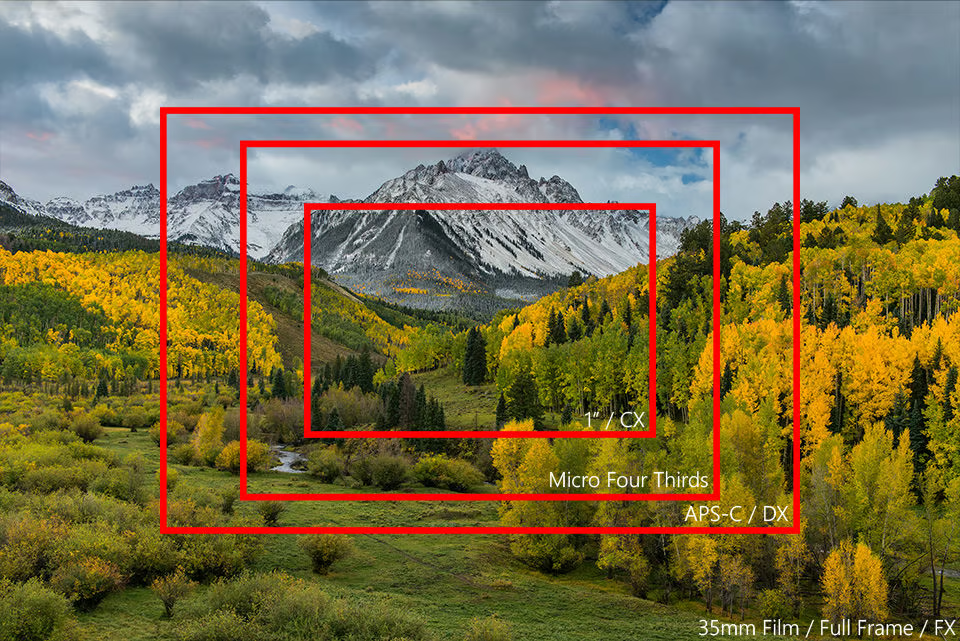
An APS-C sensor (Advanced Photo System type-C) is physically smaller than a full-frame sensor. Because the sensor is smaller, it only captures the center portion of the image circle projected by the lens. It essentially “crops” the edges out of the frame.
Because the resulting image is cropped, it appears magnified compared to the exact same shot taken on a full-frame camera. This magnification is measured by a specific multiplier, known as the crop factor.
- Sony, Nikon, Fujifilm, and PENTAX: Feature a 1.5x crop factor.
- Canon: Features a slightly smaller sensor, resulting in a 1.6x crop factor.
How Do You Calculate Focal Length Conversion?
When we talk about a lens’s focal length (e.g., 50mm), that number is a physical, optical measurement. It does not change. However, because your APS-C sensor crops the image, the effective focal length—or the equivalent field of view—changes.
To find out what your lens will actually look like when you look through the viewfinder, you simply multiply the focal length printed on the lens by your camera’s crop factor.
The Formula: Lens Focal Length × Crop Factor = Full-Frame Equivalent Field of View
Here is a handy cheat sheet of common focal length equivalents based on a 1.5x multiplier (Sony, Nikon, Fuji):
| Physical Lens (Focal Length) | Lens Type | Full-Frame Equivalent | Practical Use |
|---|---|---|---|
| 10mm | Ultra-wide | 15mm | Architecture, real estate, sweeping landscapes. |
| 18mm | Wide-angle | 27mm | Street photography, environmental portraits. |
| 35mm | Standard | 52.5mm | Everyday walkaround lens, documentary style. |
| 50mm | Short Telephoto | 75mm | Classic portraiture, isolating subjects. |
| 200mm | Telephoto | 300mm | Sports, wildlife, compression. |
(Note: If you shoot Canon, simply multiply the first column by 1.6 instead!)
Do I Need to Convert Lenses Specifically Designed for APS-C?
Yes. This is the biggest misconception in photography.
Many camera manufacturers make lenses exclusively for APS-C bodies (such as Nikon DX, Canon EF-S, or Sony E lenses). These lenses are designed to project a smaller image circle to perfectly fit the smaller sensor. This makes them lighter, smaller, and often more affordable. If you put one of these lenses on a full-frame camera, you will see heavy vignetting (dark, black circles around the corners of your image).
However, focal length is an absolute physical property. A 35mm APS-C lens and a 35mm Full-Frame lens are optically identical in terms of focal length. Therefore, you must apply the crop factor math to ALL lenses attached to an APS-C body, even if the lens was explicitly built for an APS-C camera. A 35mm APS-C lens will still give you a ~52mm equivalent field of view.
Read Also: Merchandising Photography: A Complete Guide for E-commerce Success
How Does Crop Factor Affect Aperture and Depth of Field?
It is common knowledge that crop factor changes your focal length, but how does it impact your aperture (f-stop) and background blur (bokeh)?
1. Light Gathering Stays the Same: An f/1.8 lens is an f/1.8 lens, no matter what camera it is on. The physical aperture opening does not change, meaning your exposure settings (shutter speed and ISO) will be identical on an APS-C camera as they would be on a full-frame camera.
2. Depth of Field Appears Deeper: While the physical aperture remains unchanged, the equivalent angle of view impacts your depth of field. Because you are using a wider lens to get the same framing as a full-frame camera (e.g., using a 35mm on APS-C to match a 50mm on full-frame), your depth of field will be deeper.
As a general rule, you can multiply your f-stop by your crop factor to understand the Full-Frame Depth of Field Equivalent. An f/1.8 lens on an APS-C camera will yield the background blur equivalent of roughly an f/2.7 lens on a full-frame camera.
APS-C vs. Full-Frame: Which Should You Choose?
Neither sensor size is inherently “better” than the other; they are just tools built for different jobs. Understanding the focal length conversion helps dictate which system is right for your specific needs.
Choose an APS-C Camera If:
- You shoot wildlife or sports: The crop factor acts as a free telephoto reach multiplier. A compact 300mm lens instantly gives you the reach of a 450mm+ setup, saving you thousands of dollars and saving your back from carrying heavy glass.
- You value portability: Because the sensor and the APS-C specific lenses (image circles) are smaller, your entire camera rig will be significantly lighter for travel photography.
- You are budget-conscious: APS-C bodies and dedicated crop lenses are much more affordable than their full-frame counterparts.
Choose a Full-Frame Camera If:
- You prioritize low-light performance: Larger sensors have larger individual pixels, allowing them to gather more light and produce less digital noise in dark environments.
- You want maximum background blur: For high-end portrait photography, full-frame sensors allow for incredibly shallow depths of field, resulting in creamy, smooth bokeh.
- You shoot ultra-wide angles: Without a crop factor multiplying your focal length, wide-angle lenses stay truly wide, which is ideal for tight real estate interiors or expansive astrophotography.
Final Thoughts
Navigating focal length equivalents doesn’t require a degree in optical physics. Just remember your 1.5x or 1.6x multiplier, know that the math applies to absolutely every lens you mount to your camera, and learn to use that extra “zoom” to your advantage. Once you understand how your sensor sees the world, choosing the perfect lens becomes second nature.
Frequently asked questions
Does crop factor affect video on APS-C cameras?
Yes. Many APS-C cameras apply an additional crop in certain video modes (particularly 4K), which can further narrow the field of view beyond the standard 1.5x or 1.6x. Always check your camera’s manual for the specific video crop factor at each resolution and frame rate setting.
Is a 50mm lens still a “nifty fifty” on APS-C?
Not in terms of perspective. On APS-C, a 50mm lens produces a field of view equivalent to roughly 75–80mm on full-frame — making it a short telephoto, closer to a portrait lens than a standard walkaround focal length. For a true 50mm-equivalent on APS-C, look for a 33–35mm lens.
Crop factor is a capture problem; marketplace dimensions are a delivery one. Image cropping and resizing gets one shoot into every platform’s required frame.
Does the crop factor affect image quality?
Crop factor itself does not degrade image quality. A sharp full-frame lens produces sharp images on APS-C. The quality differences between APS-C and full-frame come from sensor size affecting low-light performance and dynamic range — not from the crop factor calculation itself.