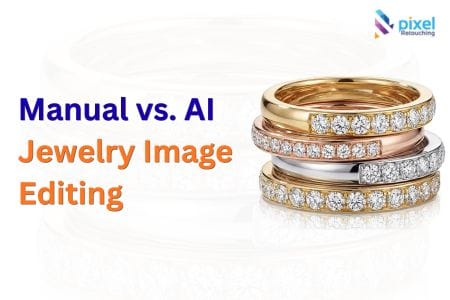
Let’s cut to the chase: for high-end jewelry retouching, manual editing is still the undisputed king. While Artificial Intelligence has made incredible strides in speed and basic corrections, it simply cannot replicate the nuanced, pixel-perfect precision that a skilled human retoucher brings to complex gemstones and precious metals. In an industry where trust is built on visual clarity, relying solely on AI risks presenting a product that looks “good enough” but fails to capture the true luxury and detail your customers expect. At Pixel Retouching, we’ve seen firsthand that while AI can handle the heavy lifting of bulk tasks, the final polish that drives conversions requires a human eye.
Key Takeaways for Jewelry Brands:
- AI is fast but flawed: Great for bulk, low-detail tasks, but risky for high-value items.
- Manual is precise: Essential for capturing the true sparkle, texture, and color of jewelry.
- Quality drives sales: High-quality, manually retouched images can increase conversions by up to 40%
- Trust is visual: Accurate representation reduces returns and builds long-term customer loyalty.
In the end, your jewelry is a work of art. It deserves an editing process that respects its craftsmanship. Choose manual retouching for results that truly shine.
75% of online shoppers rely on product photos when deciding whether to buy a product, making image quality the single most important factor in conversion .
The State of the Market: Why Quality Matters More Than Ever
The global jewelry market is projected to reach staggering heights, with estimates valuing the sector at over $242 billion in 2025 and continuing its upward trajectory. In such a saturated digital marketplace, your product images are not just photos; they are your primary salesperson.
Research consistently shows that high-quality product images can boost conversion rates by 30-40% and reduce return rates by up to 25%. When a customer can’t physically touch a diamond ring or feel the weight of a gold necklace, they rely entirely on the image. If the reflection looks fake, the stone color is slightly off, or the metal lacks its natural luster, the sale is lost. This is why understanding the limitations of AI in favor of professional Jewelry Retouching Services is critical for your brand’s reputation.
22% of product returns in e-commerce occur because the item looked different in person than it did in the photos . For jewelry, where detail is critical, this number is often higher.
Side-by-Side: AI vs. Manual Jewelry Editing
To help you decide where to invest your resources, let’s break down the key angles where AI and manual editing diverge.
1. Speed and Efficiency: The AI Advantage
There is no denying that AI wins when it comes to raw speed. Tools powered by machine learning can process hundreds of images in minutes, handling basic tasks like background removal, initial color correction, and dust spotting. For high-volume, low-cost fashion jewelry, this efficiency is tempting.
However, speed often comes at the cost of consistency. AI works based on patterns it has learned, meaning it can make unpredictable errors when faced with unique cuts, intricate prongs, or unusual lighting setups. Manual editing, while slower, ensures that every single image meets a consistent standard of excellence, which is vital for maintaining a cohesive brand aesthetic across your Professional Photo Editing & Retouching Services portfolio.
2. Precision and Detail: Where AI Fails
Jewelry is arguably the most difficult subject to retouch due to its reflective surfaces and tiny, intricate details. Here is where AI frequently stumbles:
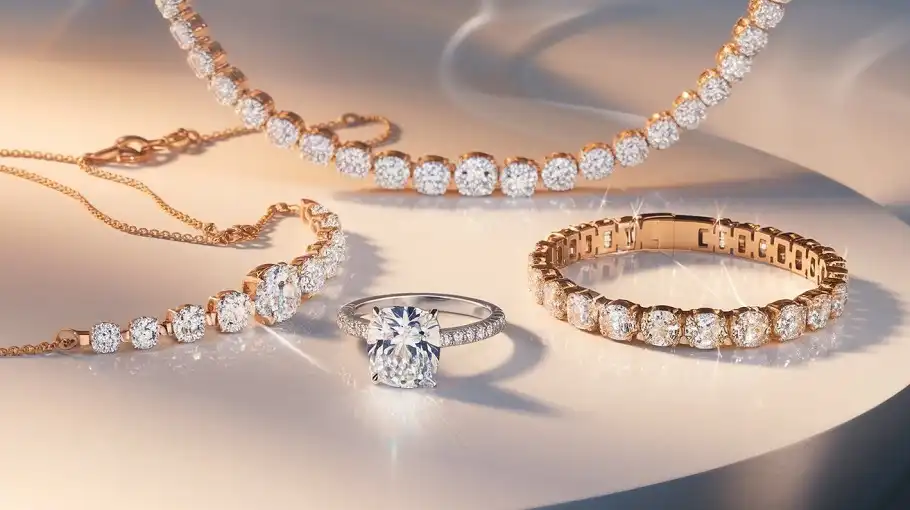
- Gemstone Integrity: AI often struggles to distinguish between a genuine facet reflection and a dust particle. It may accidentally blur or “heal” away the very sparkles that make a diamond look valuable. Manual retouchers understand the physics of light and know exactly which reflections to enhance and which to remove.
- Metal Textures: Gold, silver, and platinum have distinct textures. AI tends to over-smooth metals, making them look like plastic rather than precious metal. A human editor uses dodge and burn techniques manually to preserve the natural grain and shine of the metal.
- Complex Shapes: Intricate designs, such as filigree work or pave settings, often confuse AI algorithms. You might see merged prongs or distorted shapes in AI-edited images. Manual editing ensures every prong is sharp, every stone is seated correctly, and the geometry of the piece remains true to life.
As noted in recent industry analysis, AI tools still struggle with nuanced creative decisions and often fail to handle complex jewelry elements accurately. This is why for high-value items, the risk of AI error is simply too high.
3. Color Accuracy: The Trust Factor
One of the biggest complaints in online jewelry shopping is color discrepancy. A ruby that looks orange in the photo but arrives deep red will lead to a return. AI color correction is often generic, applying broad saturation boosts that can distort the true hue of gemstones.
Manual retouching allows for precise color calibration based on the actual product. Professional retouchers use reference samples and advanced masking techniques to ensure that the emerald green in the photo matches the emerald green in real life. This level of accuracy is non-negotiable for building customer trust and reducing costly returns.
4. Creative Control and Brand Consistency
AI follows rules; humans understand context. Your brand might have a specific mood—perhaps soft, romantic lighting for engagement rings or stark, high-contrast edits for modern minimalist pieces. AI tools often apply a “one-size-fits-all” look that can dilute your brand identity.
With manual editing, you have full creative control. You can direct your retoucher to emphasize certain features, create specific shadow effects, or composite images in ways that AI cannot yet replicate logically. This bespoke approach is what separates a generic e-commerce store from a luxury brand.
Why Jewelry Store Owners Are Returning to Manual Editing
At Pixel Retouching, we’ve been in the trenches of professional photo editing since 2012. Over more than a decade, we’ve witnessed every trend come and go, but the recent surge in AI-driven editing has created a unique phenomenon we didn’t expect: a wave of clients coming back to us after trying to go it alone with AI tools.
Here’s the untold reality that software companies won’t tell you: AI doesn’t understand jewelry; it only recognizes patterns.
We’ve seen countless scenarios where a jewelry store owner, lured by the promise of “one-click perfection,” ends up with images that look technically clean but emotionally dead. The diamonds lack fire because the AI smoothed out the critical internal reflections. The gold looks flat because the algorithm removed the subtle gradients that define its curvature. In some cases, AI has even altered the shape of prongs or merged delicate chains, creating structural impossibilities that would mislead customers and lead to costly returns.
These aren’t just minor glitches; they are brand-damaging errors. When a customer receives a ring that looks nothing like the hyper-smooth, plastic-like image on the website, trust is broken. We’ve had clients share their frustration after spending hours trying to “fix” AI-generated artifacts, only to realize that manual retouching would have been faster and far more accurate from the start.
This experience has taught us that while AI can handle about 10-15% of the basic groundwork (like initial background removal and rough dust spotting), the remaining 85-90%—which includes precise metal retouching, gemstone enhancement, shadow creation, color calibration, and structural correction—requires human expertise. These are the critical elements that transform a flat photograph into a luxurious, three-dimensional visual asset, and they are exactly where AI tools consistently fall short.
The Verdict: A Hybrid Approach?
Does this mean AI has no place in jewelry editing? Not necessarily. For initial culling, basic background removal, or low-stakes social media content, AI can be a useful tool in the workflow. However, for the final product images that appear on your website, Amazon listings, or marketing campaigns, manual retouching is essential.
Think of AI as the apprentice and the manual retoucher as the master craftsman. The apprentice can prepare the workspace, but only the master can deliver the finishing touches that turn a good photo into a great one
Frequently Asked Questions
Can I use AI tools for jewelry retouching?
Yes, for basic tasks like background removal. However, for complex editing involving intricate details, manual retouching is essential to maintain professional quality and accuracy.
Does using AI for jewelry editing increase return rates?
It can. AI often distorts colors or stone clarity, creating a mismatch between the photo and the physical product. Accurate manual retouching sets realistic expectations, reducing customer disappointment and returns.
Is manual retouching worth the extra cost compared to AI?
Absolutely. While AI is cheaper upfront, manual editing drives higher conversions and protects your brand reputation. The ROI from increased sales and fewer returns far outweighs the initial service cost.
What specific details does AI fail to edit correctly?
AI commonly struggles with sharp diamond facets, delicate prongs, and individual chain links. It often blurs these fine details or merges them incorrectly, whereas manual editing preserves every intricate element precisely.