The best prime lens for product photography is usually a 90mm to 105mm macro. It focuses close enough for rings and labels, it sits far enough back to keep your lights out of the reflections, and it doesn’t stretch a product’s shape the way a wide lens does. For larger products like shoes, bags and apparel, a 50mm prime is the better, cheaper pick.
So the right answer depends on what you sell, not on which lens tops a review chart.
We retouch thousands of product photos every week. The lens choice shows up in every file: in how much the edges bend, how much glare sits on a bottle, and how much of a ring is actually sharp. This guide picks lenses by that standard.
Quick picks
| Pick | Lens | Mount | Max magnification | Closest focus |
|---|---|---|---|---|
| Best overall (Canon) | Canon RF 100mm f/2.8L Macro IS USM | Canon RF | 1.4x | 26 cm |
| Best overall (Sony) | Sony FE 90mm f/2.8 Macro G OSS | Sony E | 1x | 28 cm |
| Best overall (Nikon) | Nikon Z MC 105mm f/2.8 VR S | Nikon Z | 1x | 29 cm |
| Best for Fujifilm | Fujifilm XF 80mm f/2.8 R LM OIS WR Macro | Fujifilm X | 1x | 25 cm |
| Best third-party macro | Sigma 105mm f/2.8 DG DN Macro Art | Sony E, L-Mount | 1x | 29.5 cm |
| Best budget all-rounder | Canon RF 50mm f/1.8 STM | Canon RF | 0.25x | 30 cm |
| Best small-space macro | Nikon Z MC 50mm f/2.8 | Nikon Z | 1x | 16 cm |
| Best half-macro portrait/product hybrid | Canon RF 85mm f/2 Macro IS STM | Canon RF | 0.5x | 35 cm |
Specs are from each manufacturer. Check current prices before you buy, since they change often.
Why a prime lens for product photography?
A zoom is more flexible. A prime is more consistent. And consistency is the whole job in product photography.
When you shoot 200 SKUs for a catalogue, every product needs the same perspective, the same size in frame and the same sharpness. A prime locks that in. You can’t drift from 50mm to 62mm halfway through the day, because the lens doesn’t let you.
Primes are also sharper at the same price, lighter on a tripod, and usually focus closer. For small products, that last point decides everything.
Which focal length fits your products?
Short answer: the smaller the product, the longer the lens. Here’s how focal length changes the shot.
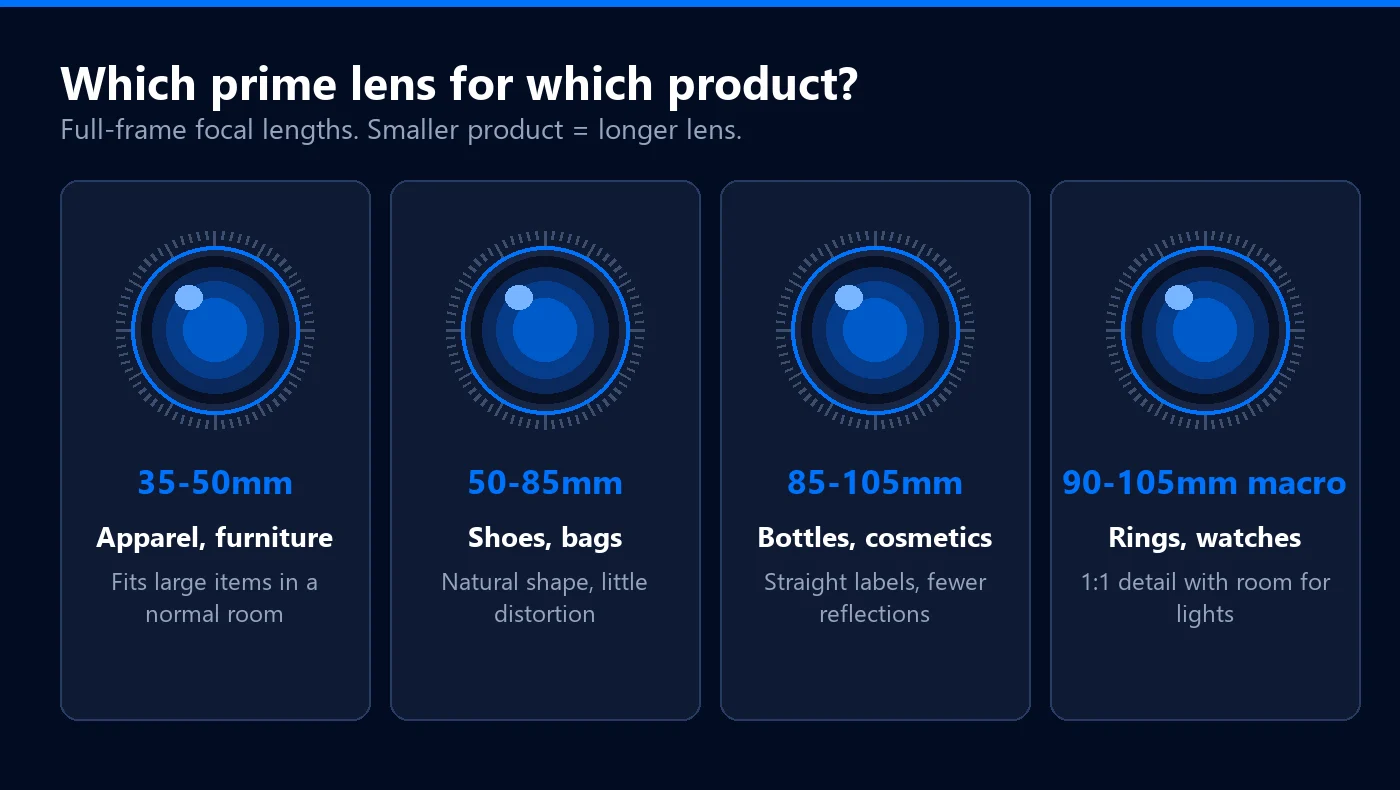
| Product size | Examples | Focal length (full frame) | Why |
|---|---|---|---|
| Tiny | Rings, earrings, watch dials, SD cards | 90mm to 105mm macro | Needs 1:1 magnification and room for lights |
| Small | Cosmetics, bottles, phone cases | 85mm to 105mm | Keeps labels straight and reflections controlled |
| Medium | Shoes, bags, small appliances | 50mm to 85mm | Natural shape without needing a long room |
| Large | Apparel on a mannequin, furniture | 35mm to 50mm | Fits the whole product in a normal studio |
Shooting APS-C? Multiply by your crop factor (1.5x for Nikon, Sony and Fuji, 1.6x for Canon). A 60mm macro on APS-C acts like a 90mm on full frame. Our guide to crop factor and focal length explains the math.
The best prime lenses for product photography, by system
Canon RF 100mm f/2.8L Macro IS USM
Best for: jewellery, cosmetics and any small product where detail sells.
It goes past life size to 1.4x magnification, which is rare. That means a stud earring can fill the frame. The image stabilizer helps when you shoot handheld at a trade show or pop-up, but on a tripod, switch it off.
Watch out for: the Spherical Aberration (SA) control ring. It’s built to soften portraits. For products, keep it at zero, or edges go dreamy in a way no retoucher can fully undo.
Sony FE 90mm f/2.8 Macro G OSS
Best for: Sony shooters doing mixed small-product work.
It’s been the default Sony macro for a decade for good reason: sharp at f/8 to f/11 across the frame, with neutral colour. The focus clutch pull makes manual focus quick when you’re stacking.
Watch out for: autofocus hunts at 1:1. For close work, switch to manual and move the camera on a focus rail.
Nikon Z MC 105mm f/2.8 VR S
Best for: Nikon mirrorless shooters who want one lens for jewellery, watches and beauty.
It’s very sharp and focuses fast for a macro. The S-line coatings keep flare under control when a softbox sits just out of frame, which is common when you light a bottle from behind.
Fujifilm XF 80mm f/2.8 R LM OIS WR Macro
Best for: Fujifilm users. It acts like a 120mm on full frame.
That longer reach gives more working distance from small, shiny products, so your camera’s reflection is less likely to land in a watch face or a ring band.
Sigma 105mm f/2.8 DG DN Macro Art
Best for: Sony E and L-Mount shooters who want top sharpness for less money than first-party glass.
It’s one of the sharpest macro lenses made. The trade-off is slower autofocus, which barely matters in product work, since you’ll focus manually most of the time anyway.
Canon RF 50mm f/1.8 STM
Best for: starting out, and for medium to large products.
It’s small, light and inexpensive. For shoes, bags and folded apparel, it does the job well. It can’t do jewellery, though: at 0.25x, a ring stays small in the frame no matter how close you get.
Nikon Z MC 50mm f/2.8
Best for: tight home studios.
It reaches 1:1 at just 16 cm. That’s handy when you don’t have room to step back. The catch: at that distance, the lens almost touches the product, and your lights have nowhere to go. Use it for flat items and labels, not shiny curved ones.
Canon RF 85mm f/2 Macro IS STM
Best for: photographers who shoot both headshots and products.
It’s a flattering portrait lens and a 0.5x half-macro. That’s close enough for cosmetics and watches, though not for small earrings.
What to look for when you buy
- Magnification: 1x (1:1) for jewellery and tiny items. 0.25x to 0.5x is fine for anything bigger than a hand.
- Working distance: the space between the front of the lens and the product. More space means easier lighting and fewer reflections.
- Sharpness at f/8 to f/11: that’s where you’ll shoot most of the time, not wide open. Ignore f/1.4 hype for product work.
- Low distortion: straight edges on boxes and bottles should stay straight. Macro primes are usually best here.
- Manual focus feel: a smooth, well-damped focus ring matters for focus stacking.
What a retoucher sees in the files
Here’s the part reviews miss. Every lens choice changes how much work happens after the shoot.
- Shot too wide, too close: bottle necks bulge and boxes lean. We can correct some of it, but labels warp when we do.
- Shot at f/2.8 on a ring: only the front prong is sharp. No amount of sharpening fixes missing focus. Stack it, or shoot at f/11.
- Shot with a short macro on chrome: the camera and photographer show up in the reflection. That’s an extra 10 to 15 minutes per image to clean.
- Shot with a 100mm macro at f/11 and a stack: clean edges, even detail, easy cutout. That’s the file we hope for.
Good glass makes better raw material. But even the best lens can’t give you a pure white background, a natural shadow or a catalogue-wide colour match. That’s what our eCommerce photo editing services handle, from $0.39 per image. For jewellery, see our jewellery retouching services.
Already shooting Nikon? Our list of the best Nikon lenses for product photography includes zooms and F-mount options. And if you’re building a full kit, start with our product photography equipment guide.
The bottom line
If you sell small things, buy a 90mm to 105mm macro for your system and keep it on the tripod. If you sell bigger things, a 50mm prime does the job for a fraction of the price. Either way, the best prime lens for product photography is the one that gives you the same frame on product 200 as on product 1.
Frequently asked questions
Is 50mm good for product photography?
Yes, for medium and large products. A 50mm prime works well for shoes, bags, apparel and small furniture. It’s not ideal for jewellery or tiny items, because most 50mm lenses can’t focus close enough to fill the frame with a small product.
Do I need a macro lens for product photography?
Only for small products. If you photograph jewellery, watches, cosmetics or anything smaller than your hand, a macro lens with 1:1 magnification is close to essential. For larger products, a standard prime or zoom is enough.
Is 100mm or 60mm macro better for products?
A 100mm macro is usually better on full frame. It gives you twice the working distance at the same magnification, which leaves room for lights and keeps your reflection out of shiny products. A 60mm macro is better on APS-C cameras or in very small spaces.
What aperture should I use for product photography?
Use f/8 to f/11 for most product shots. That range keeps the whole product sharp while avoiding the softness from diffraction at f/16 and beyond. For jewellery at close range, combine f/8 with focus stacking.
Is a prime or zoom lens better for product photography?
A prime lens is usually better. It’s sharper for the price, focuses closer and keeps the same perspective across every product in a catalogue. A zoom like a 24-70mm is more flexible for mixed shoots, but primes give more consistent results.