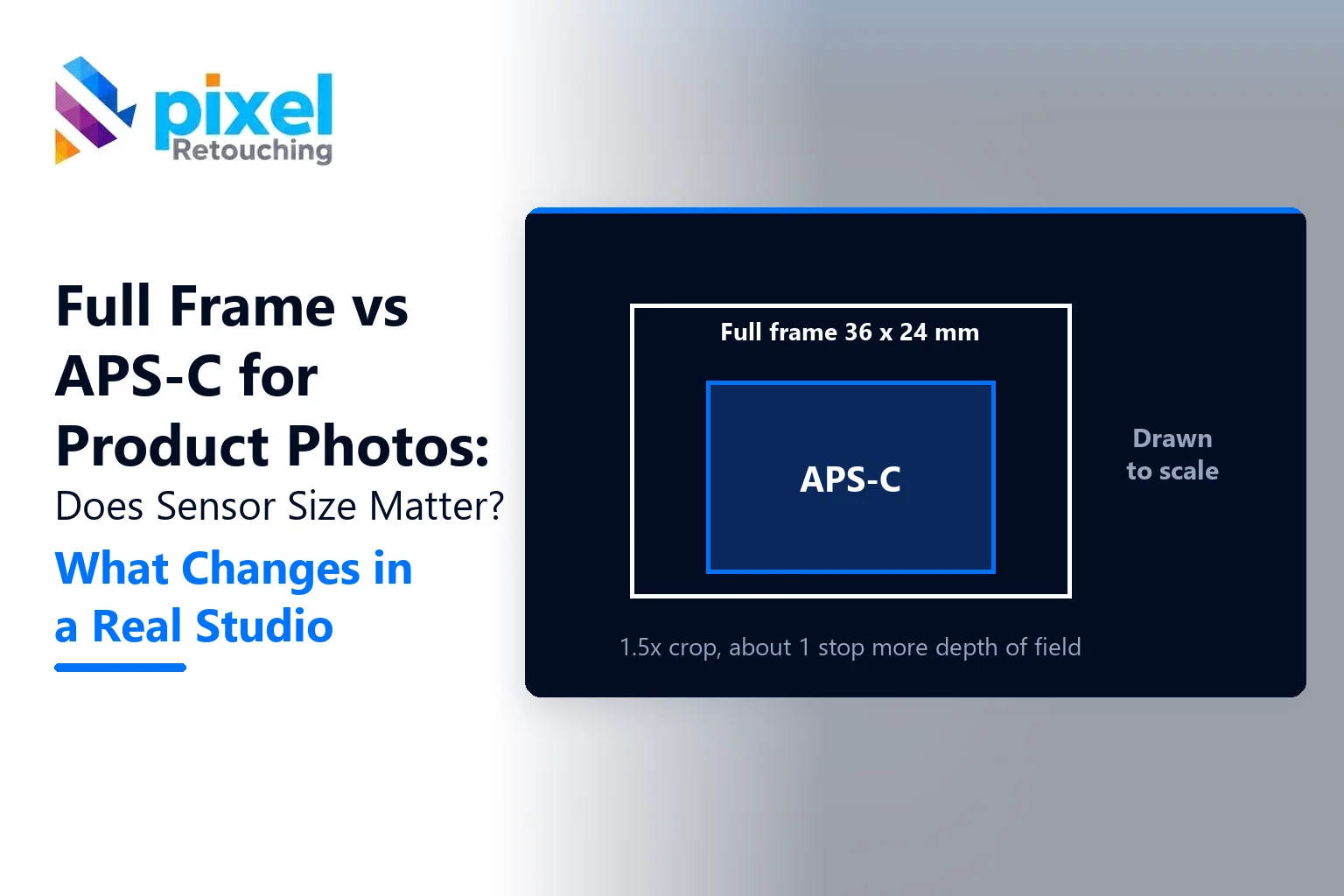
For most product photography, APS-C is enough. Full frame vs APS-C matters far less in a studio than it does at a wedding, because product shots are usually taken at ISO 100, at f/8 to f/11, on a tripod, under controlled light. In those conditions, a good APS-C camera and a full frame camera produce files that look almost the same online. Full frame earns its price in three cases: large prints, very high resolution needs, and shooting in low light.
Many photographers believe a bigger sensor always means better product photos. In the studio, it often doesn’t.
The difference in one table
| APS-C | Full frame | |
|---|---|---|
| Sensor size | About 23.5 x 15.6 mm | 36 x 24 mm |
| Crop factor | 1.5x (1.6x Canon) | 1x |
| Typical resolution | 24 to 40 MP | 24 to 61 MP |
| Depth of field at the same framing and f-stop | Deeper (more in focus) | Shallower |
| High ISO noise | More | Less |
| Body and lens cost | Lower | Higher |
| Lens choice for macro | Good | Wider |
Myth 1: “Full frame is sharper”
Sharpness depends on resolution, the lens and focus, not sensor size alone. A 33 MP APS-C body has more pixels than a 24 MP full frame body. For a 2,000 pixel Amazon or Shopify image, both have far more detail than you’ll ever show.
Where full frame does pull ahead is with very high resolution bodies (45 to 61 MP) and top lenses. That matters for billboards, large catalogue prints and heavy cropping. It doesn’t matter much for a product grid on a website.
Myth 2: “You need full frame for a blurred background”
True, but it’s usually the wrong goal. Most product shots need the whole product sharp, from the front edge to the back. And here APS-C actually helps.
At the same framing and the same f-stop, APS-C gives you about one stop more depth of field. So f/8 on APS-C looks roughly like f/11 or f/12 on full frame. That means less focus stacking and less risk of diffraction softness.
| To get this depth of field… | APS-C | Full frame |
|---|---|---|
| Medium product, fully sharp | f/8 | about f/11 to f/13 |
| Small product, close up | f/11 | about f/16 (diffraction starts to soften) |
| Soft background for lifestyle shots | f/2.8 | about f/4 |
Myth 3: “APS-C is too noisy for professional work”
In a studio, you shoot at base ISO with strobes or continuous lights. At ISO 100, modern APS-C sensors are very clean. Noise only becomes a real problem in low light, like shooting products on location in a dim shop or restaurant.
Where full frame really wins
- Large prints and big crops: 45 MP and up gives room to crop several products from one frame, or print catalogue spreads.
- Low light on location: roughly one stop cleaner at the same ISO.
- Lifestyle and model shots: easier background blur for fashion and on-model product work.
- Tilt-shift lenses: mostly designed for full frame, and loved by furniture and packaging photographers.
Where APS-C really wins
- Cost: the money you save can buy better lights, which improve product photos more than a sensor upgrade.
- Depth of field: more of the product sharp at a given f-stop.
- Macro reach: a 100mm macro frames like a 150mm, giving more working distance for jewellery and small items.
- Size and weight: smaller bodies and lenses for travel and small studios.
For the maths behind the crop factor, see our guide to APS-C crop factor and focal length.
So which should you buy?
| If you shoot… | Choose |
|---|---|
| Products for your own online shop | APS-C |
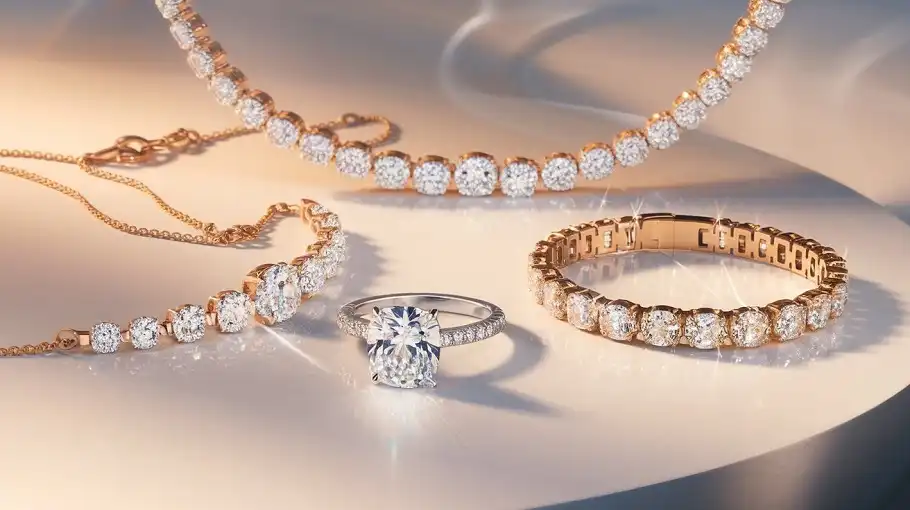
| Jewellery and small items | APS-C with a macro lens |
| Catalogues for print, or big crops | Full frame, high resolution |
| Fashion and on-model product shots | Full frame |
| Products and portraits or weddings | Full frame |
| Furniture and interiors with tilt-shift lenses | Full frame |
Choosing lenses for your system? Our list of the best Nikon lenses for product photography covers both DX (APS-C) and FX (full frame) options.
What matters more than the sensor
We retouch thousands of product photos every week, shot on everything from phones to medium format. The files that need the least work aren’t defined by sensor size. They’re defined by three things: even lighting, a correct white balance and sharp focus across the whole product.
And whatever camera you use, the final steps are the same: a pure white background, a natural shadow, colour that matches the real product and a consistent crop. Our product photo editing services handle that from $0.39 per image, with three free test images.
The verdict
In full frame vs APS-C for product photography, APS-C is the smart choice for most sellers and small studios. Spend the difference on lights and a good macro lens. Choose full frame when you need print-level resolution, on-model shots or tilt-shift lenses. Your customers will judge the photo, not the sensor.
Frequently asked questions
Is APS-C good enough for product photography?
Yes. In a studio at base ISO and f/8 to f/11, a modern 24 to 33 MP APS-C camera produces product photos that look the same as full frame for websites and marketplaces. Full frame matters for large prints, heavy cropping and low light.
Does full frame give better product photos?
Not automatically. Lighting, focus, lens quality and white balance affect product photos far more than sensor size. Full frame helps with low-light noise, background blur and very high resolution, which most product shots don’t need.
Why does APS-C have more depth of field?
To frame the same shot, APS-C uses a shorter lens or a greater distance than full frame. At the same f-stop, that gives about one stop more depth of field, so more of the product is in focus.
What resolution do I need for product photography?
For online stores, 20 to 24 MP is plenty. Amazon recommends images of at least 1,000 pixels on the longest side for zoom, and most stores display 2,000 to 3,000 pixels. Higher resolution helps for print and cropping.
Is a full frame camera worth it for jewellery photography?
Usually not. Jewellery needs deep depth of field and close focusing, where APS-C with a 60mm or 100mm macro lens works very well. Full frame helps only if you need very large, high-resolution campaign images.