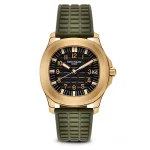
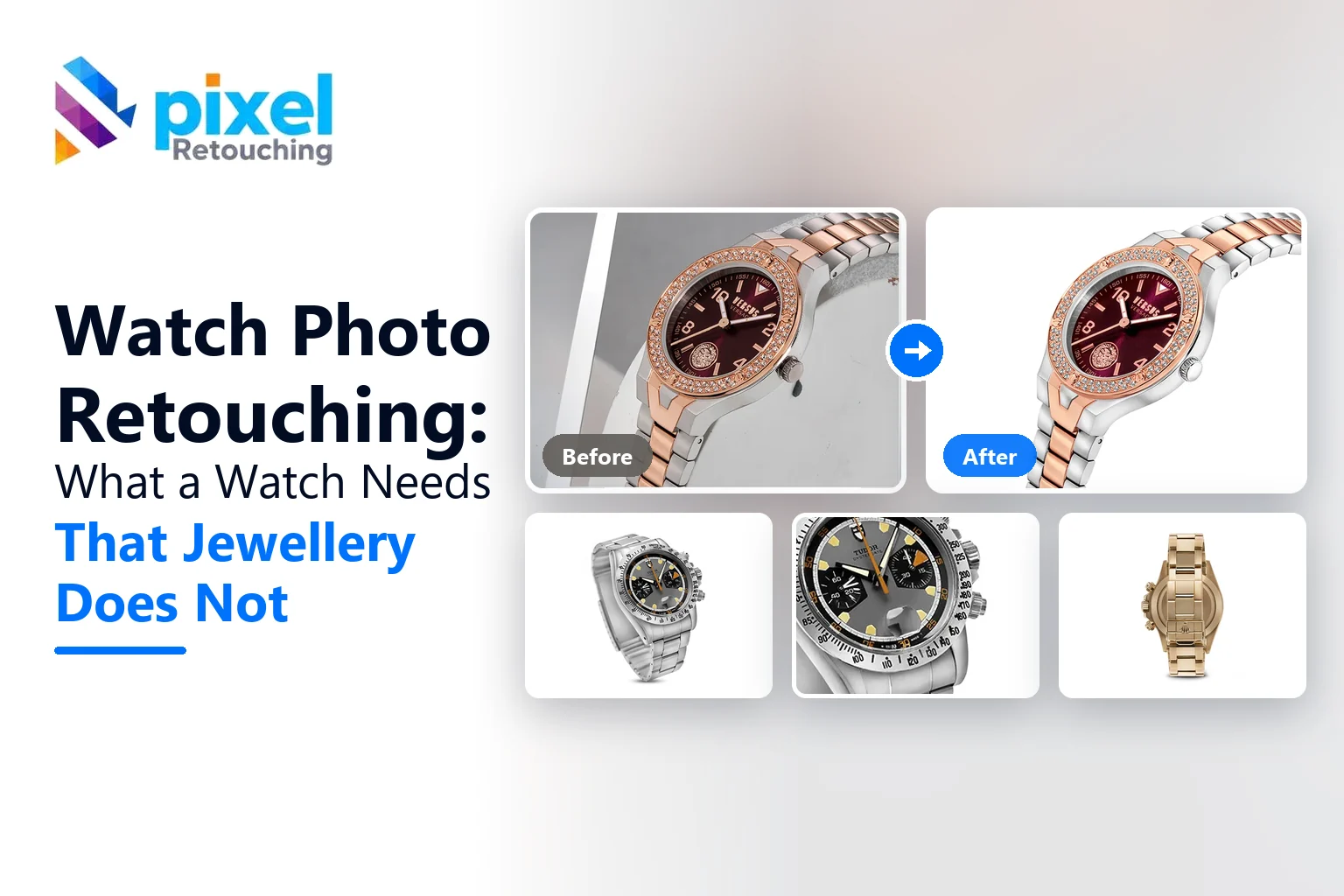
Watches get filed under jewellery and then behave nothing like it. A ring is metal and stone; a watch is metal, glass, text, a brand mark, and a dial with printing that has to survive whatever you do to it. The editing decisions that make a ring look expensive will make a watch look wrong.
This is what changes when the piece on the table is a watch, and what to ask for, whether you are editing it yourself or briefing somebody.
These images are not AI output. Every before and after is real client work retouched by hand at Pixel Retouching, shown as the standard rather than as a demonstration of a tool.
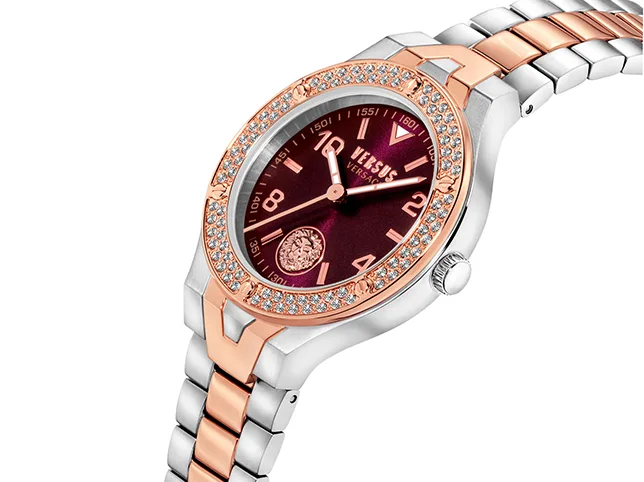
The crystal is the hardest surface in product photography
A watch crystal has to do two contradictory things in one frame: read as glass, and let the dial through completely. Remove every reflection and the crystal stops being glass: the bezel reads as a flat printed circle and the whole watch looks like a render. Leave the reflections and the dial is unreadable, which on a listing is a missing specification.
The work is selective: take out the reflections that show the studio, the lights and the photographer, keep the ones that describe the curve of the glass. That is a judgement on every individual highlight, and it is why watch retouching costs more than a plain band.
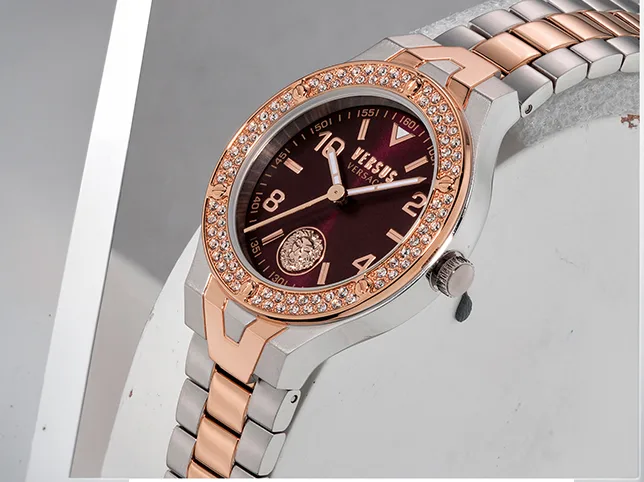
Before
After
Crystal-bezel watch retouching. Reflections managed rather than deleted. Drag to compare.
The dial is text, and text is where edits go wrong
Everything printed on a dial is a factual claim: the brand name, the model, the water resistance, the date window, the sub-dial markings. None of it may be redrawn, resampled or nudged.
This is the specific reason to be careful with automated tools on watches. Asked to clean or sharpen a dial, a model will reconstruct small text as something text-shaped: a brand name that is almost right. An almost-right logo on a listing is a trademark problem before it is a photography one, and it is the kind of thing a brand owner notices immediately.
If you take one rule from this article: read the dial in the finished file against the watch in your hand, at full size, every time.
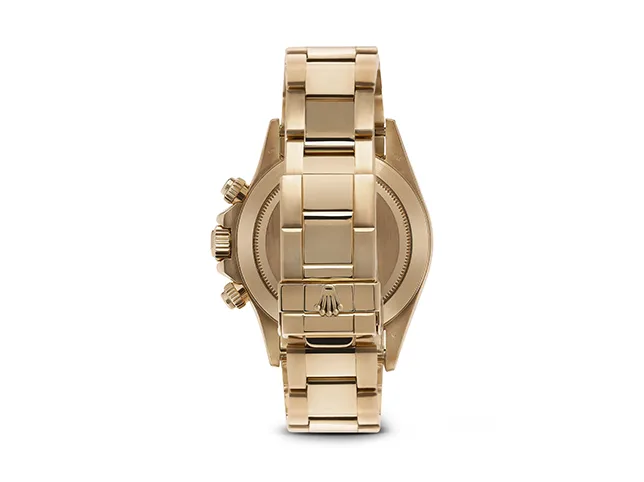
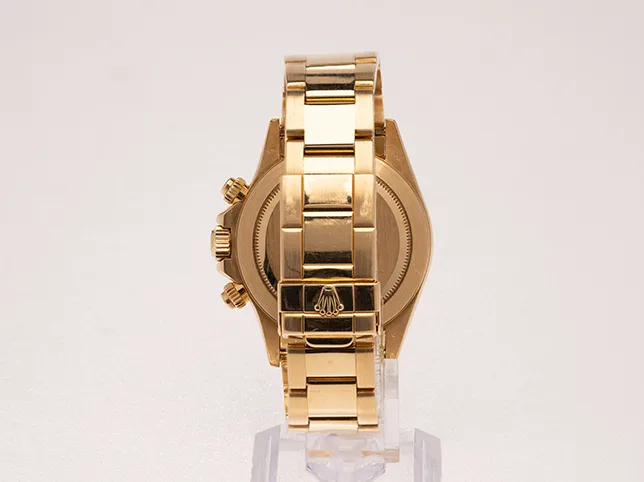
Before
After
Gold watch retouching. The case is cleaned; nothing on the dial moves.
Two finishes on one case
Most watch cases and bracelets use brushed and polished metal together, often on adjacent surfaces. That contrast is a large part of what makes a watch look well made.
It is also the first thing lost to a heavy clean-up. Even out the metal too aggressively and the brushing disappears into the polish, leaving a case that reads as a single moulded piece. The instruction that prevents it is explicit: preserve the difference between brushed and polished rather than making the whole case uniform.
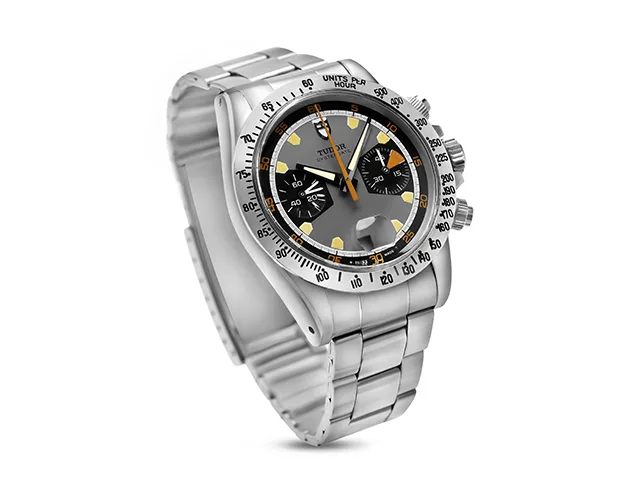
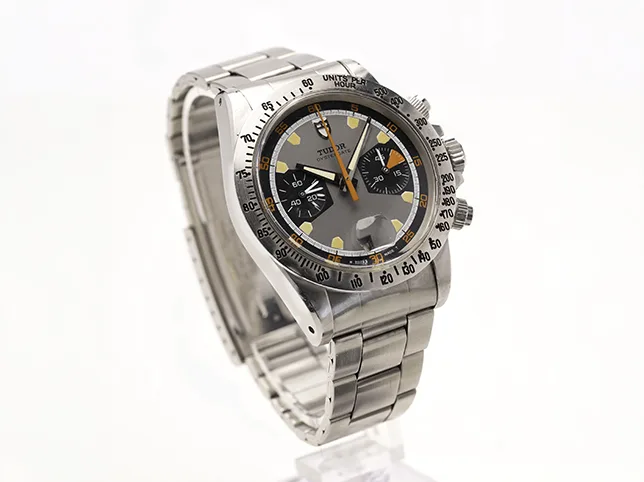
Before
After
Watch retouching. Brushed and polished have to stay different from each other.
Scratches: which ones go
A new watch photographed under macro light shows handling marks that were invisible in the room. Those go: they are a photography artefact, not the product.
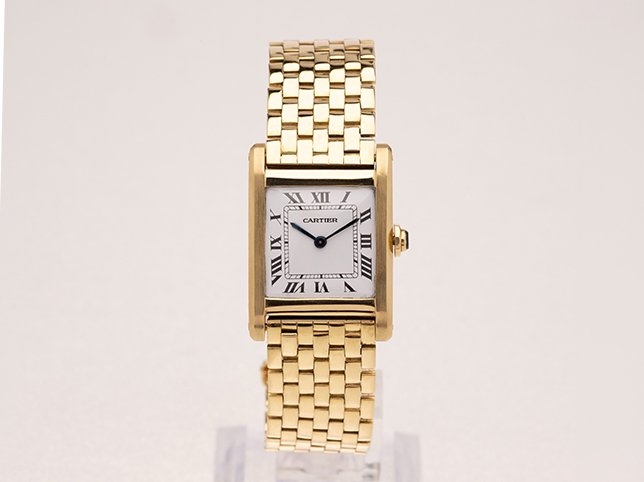
A pre-owned watch is a different question entirely, and it is worth being deliberate. Wear on a second-hand watch is part of the description, and removing it creates a gap between the listing and the parcel. The defensible split most resellers land on: remove dust, smears and handling marks from the shoot; keep genuine wear, and photograph it deliberately in a separate frame so the buyer is not surprised.
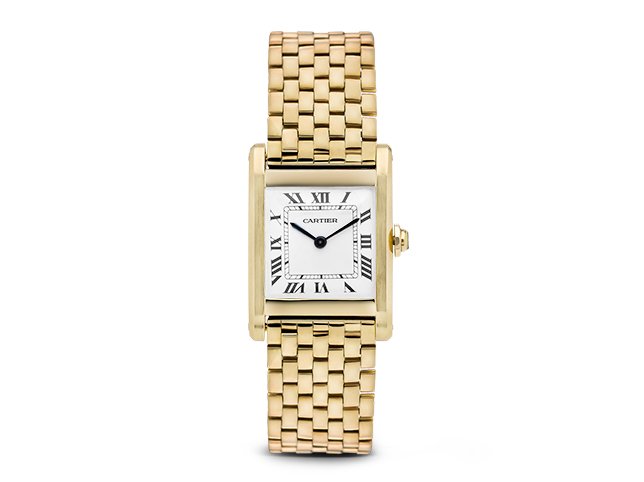
Before
After
A resale listing. Clean the shoot, keep the wear.
Bracelets, and why they are worse than chains
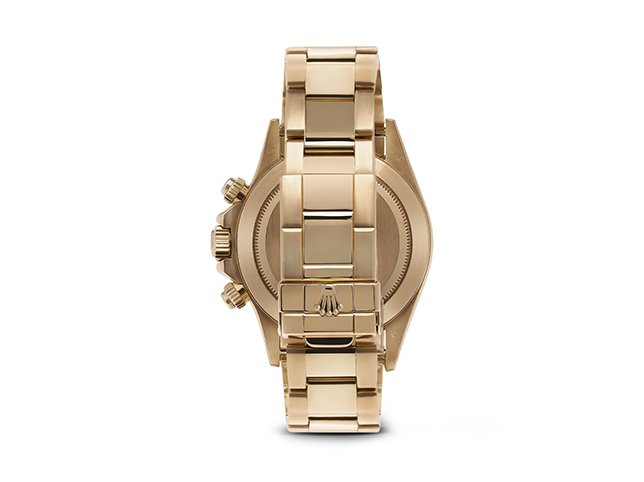
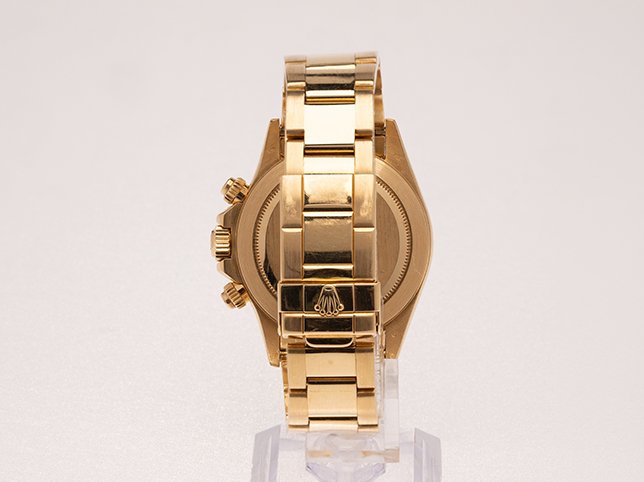
A metal bracelet is dozens of identical links, each with its own highlight, curving away from the camera. Two things go wrong.
The first is repetition: an editor or a tool that resolves one link and repeats it produces a bracelet that looks convincing until somebody compares two links. The second is depth of field: a bracelet curving away is partly out of focus in a single exposure, which is why watch photography leans on focus stacking as heavily as ring photography does.
Before
After
Every link keeps its own highlight rather than becoming a copy of its neighbour.
Shadow and reflection on a watch
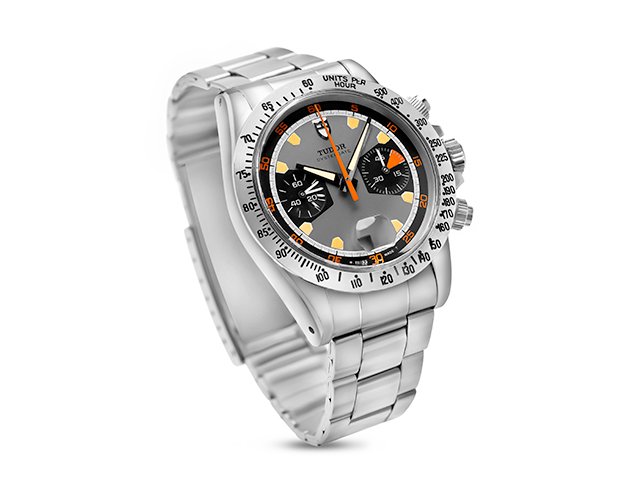
Watches follow jewellery here with one difference: they are heavier, and the treatment should say so. A mirror reflection suits a dress watch and a polished bracelet. A contact shadow suits a tool watch, a leather strap, or anything matte, and it does a better job of conveying weight, which on a watch is part of the product.
Whichever you choose, hold it across the whole collection. We have written the full decision out in reflection, contact shadow or nothing.
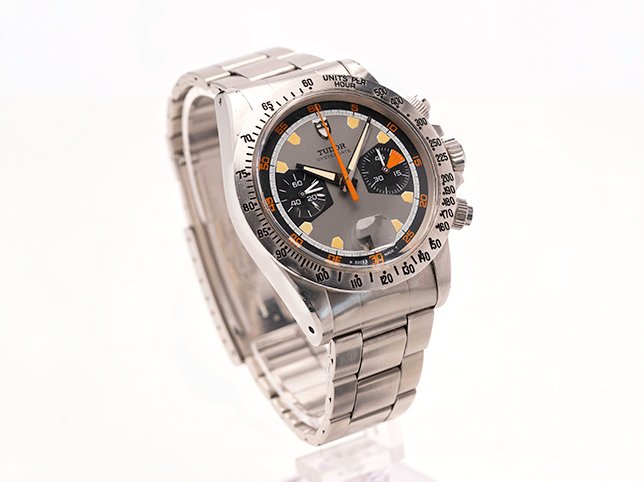
Before
After
A finished listing image. Clean case, legible dial, weight still readable.
A brief that covers a watch
If you are sending watches to a retoucher, five lines are enough:
- Nothing on the dial may be redrawn, moved or resized: branding, indices, date window, sub-dials.
- Keep the crystal reading as glass; remove studio reflections only.
- Preserve the difference between brushed and polished surfaces.
- Remove handling marks from the shoot; keep genuine wear if the watch is pre-owned.
- Name your shadow treatment and use it across the collection.
That is the brief our own team works to on jewellery and watch retouching, and it is the same one we would hand to anybody else.
Frequently asked questions
Is watch retouching different from jewellery retouching?
It overlaps, but a watch adds three things a ring does not have: a glass crystal that must stay glass, printed text that must not be altered, and two metal finishes on one case. Those three account for most of the extra work.
Why do my watch photos show the studio in the crystal?
Because a crystal is a curved mirror. It is managed at the shoot with a light tent or polarising filter and finished in retouching: selectively, so the glass still reads as glass.
Should I remove scratches from a pre-owned watch?
Remove handling marks and dust from the shoot. Keep genuine wear, and photograph it deliberately in its own frame. A listing image that hides wear produces a return and a dispute.
Can AI retouch watch photos?
For background work, often yes. For the dial, no: models reconstruct small text as something text-shaped that is not your branding, which on a watch listing is a trademark issue. Check any automated result against the watch itself.
What is focus stacking and does a watch need it?
Combining several exposures focused at different depths so the whole piece is sharp. A bracelet curving away from the camera is the classic case, and yes, most watch product photography benefits from it.
How much does watch photo retouching cost?
More than a plain band and less than a multi-stone piece, because the crystal and the two finishes take judgement rather than time. Our rates are on the price list.
Send us the watch you are least happy with
If a crystal has beaten you, or a dial has come back looking slightly wrong, that is the one to send. Three images through the free trial, edited by hand, back within 24 hours, no card.