Artificial intelligence has changed commercial photo editing almost overnight. Tasks that once took skilled retouchers hours can now be completed in seconds. Background removal, shadow generation, object cleanup, image upscaling, and even lifestyle scene creation have become accessible to anyone with an AI-powered editing tool.
This shift has encouraged many online sellers to ask a reasonable question: If AI can produce professional-looking product images so quickly, is manual photo retouching still necessary?
The short answer is yes, especially if your business depends on customer trust.
The discussion is no longer about whether AI is capable. It clearly is. The real question is whether AI can consistently create product images that accurately represent what customers will receive. That distinction matters because product photography is not simply about creating attractive visuals. It is about reducing uncertainty during the buying journey.
Research consistently shows that online shoppers rely heavily on product images before making a purchase. According to the Baymard Institute, insufficient or poor-quality product images are among the leading reasons shoppers hesitate to complete a purchase. When customers cannot physically inspect an item, photography becomes their primary source of confidence.
This is exactly where manual retouching continues to outperform automation.
AI Creates Attractive Images. Professional Retouchers Create Accurate Ones.
Most AI editing tools are designed to improve efficiency rather than verify accuracy. They analyze millions of similar images, predict missing information, and generate what appears to be the most realistic result.
For creative marketing campaigns, this approach works remarkably well.
Commercial product photography, however, follows a different standard.
Customers expect product images to be a truthful representation of the item they are purchasing. They examine stitching on clothing, reflections on watches, texture on leather bags, engraving on jewelry, and labels on packaged goods. Even subtle differences between the product image and the delivered item can reduce confidence in the brand.
Professional retouchers understand this responsibility. Instead of allowing software to make creative assumptions, they make deliberate decisions that preserve the product’s original appearance while improving the quality of the photograph.
That difference is difficult to notice during editing, but it becomes highly visible after the product reaches the customer.
Small AI Mistakes Can Quietly Reduce Sales
One of AI’s biggest strengths is automation. Unfortunately, automation also introduces inconsistency because AI generates results based on probability rather than product knowledge.
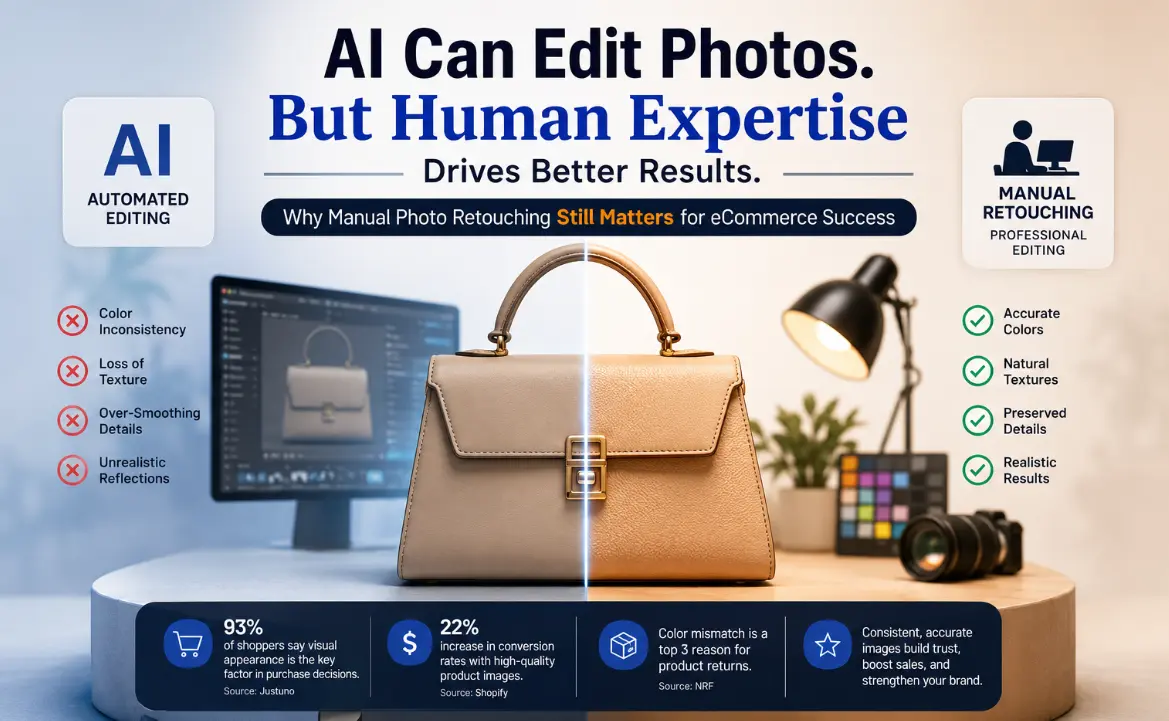
A slight color shift may seem harmless inside an editing application, but it can completely change customer expectations.
Imagine a customer purchasing a beige handbag because it complements a specific outfit. If AI editing makes the product appear lighter than it actually is, the customer may feel misled when the package arrives, even though the manufacturer made no mistake.
The same problem appears across many product categories.
AI may soften the natural grain of leather, remove fine embroidery from clothing, distort reflective surfaces, or slightly reshape packaging while attempting to improve the overall image.
Individually, these edits appear insignificant.
Collectively, they create a buying experience built on inaccurate expectations.
For an eCommerce business, inaccurate expectations often translate into lower conversions, more returns, and weaker customer loyalty.
Customer Trust Is Built Long Before Checkout
Modern consumers make purchase decisions remarkably quickly. Multiple eye-tracking studies published by the Nielsen Norman Group show that users evaluate visual content before reading detailed product descriptions. High-quality photography creates an immediate impression of professionalism, while inconsistent or unrealistic images create hesitation.
This is particularly important because trust directly affects conversion rates.
When customers believe product photography accurately represents reality, they feel more confident placing an order. When something appears overly edited or artificially generated, uncertainty increases.
That uncertainty often leads customers to continue browsing rather than completing their purchase.
Professional retouchers understand that the objective is not to create the most dramatic image. The objective is to remove distractions while preserving authenticity.
The product should look like its best version, not a different version.
Returns Often Begin With Product Photography
Returns are expensive for every online retailer.
They involve shipping costs, customer service time, inventory management, payment processing, and in many cases the permanent loss of a customer.
According to the National Retail Federation and multiple fashion industry reports, one of the most common reasons customers return apparel is that the product looks different from what they expected online. Color variation, texture differences, and inaccurate visual representation continue to rank among the leading causes of dissatisfaction.
AI editing cannot always distinguish between enhancing an image and altering the product itself.
Professional retouchers can.
That distinction protects businesses from one of the most overlooked costs in eCommerce.
Saving a few dollars on editing means very little if inaccurate images generate higher return rates.
Consistency Is a Competitive Advantage
Successful brands are instantly recognizable because their visual presentation remains consistent across every product.
Lighting appears identical.
Margins stay uniform.
Background brightness never changes.
Colors remain consistent throughout the catalog.
This level of consistency is rarely achieved by running thousands of images through the same AI workflow.
Different products respond differently to light. Transparent glass behaves differently from matte plastic. Silver jewelry reflects light differently than gold. Velvet absorbs light differently than cotton.
Professional retouchers adjust each image individually while maintaining a consistent brand standard across the entire catalog.
This combination of flexibility and consistency is something AI still struggles to deliver without extensive supervision.
For growing brands, consistency is not merely a design preference. It becomes part of brand identity.
Premium Products Require Premium Accuracy
The higher the product price, the more closely customers inspect every image.
Someone buying a $20 notebook may spend only a few seconds looking at product photos.
Someone purchasing a $2,000 engagement ring behaves very differently.
Luxury buyers zoom into gemstones.
Fashion customers inspect stitching.
Furniture buyers examine wood grain.
Electronics customers study ports, buttons, and finishes.
These purchasing decisions rely on visual accuracy.
Even advanced AI models occasionally invent details, remove imperfections that are actually product features, or create reflections that do not exist.
Professional retouching preserves every meaningful characteristic while improving clarity, lighting, and presentation.
For premium brands, that accuracy directly supports higher perceived value.
AI Works Best With Human Expertise, Not Instead of It
The most successful commercial photography workflows today are not choosing between AI and manual retouching.
They combine both.
AI dramatically reduces repetitive production tasks such as masking, background removal, and basic enhancements.
Experienced retouchers then review every image for color accuracy, product fidelity, alignment, texture preservation, and overall quality.
This hybrid workflow has become increasingly common among agencies and enterprise retailers because it delivers the efficiency of automation without sacrificing quality.
Instead of replacing human editors, AI allows them to spend more time making decisions that genuinely affect customer perception.
Why Professional Retouching Is Still an Investment
Businesses often compare the price of AI software with the cost of professional editing.
That comparison overlooks a much larger financial picture.
Product images influence click-through rates, conversion rates, customer trust, return rates, and long-term brand perception. A single inaccurate image can cost far more in lost sales than the editing budget required to produce it correctly.
Professional retouching should therefore be viewed as part of a company’s quality assurance process rather than simply a design expense.
The goal is not to make products look unrealistic.
The goal is to remove everything that prevents customers from seeing the product exactly as it is.
If you have decided accuracy matters more than speed, high-end photo retouching is that decision carried out by hand.
Final Thoughts
Artificial intelligence has undoubtedly transformed commercial photo editing. It enables businesses to process larger catalogs, reduce production time, and automate repetitive tasks that once consumed valuable creative resources. For many everyday editing jobs, AI is an exceptional productivity tool.
However, product photography serves a purpose beyond efficiency. Every image represents a promise between a business and its customers. When that promise is accurate, customers buy with confidence. When it is exaggerated or inconsistent, trust begins to erode.
Manual photo retouching continues to play a vital role because experienced editors understand something AI cannot fully replicate: commercial judgment. They know which imperfections should be removed, which product details must remain untouched, and how subtle editing decisions influence purchasing behavior.
The future of product photography is unlikely to belong exclusively to AI or to human editors. Instead, the strongest workflow combines the speed of artificial intelligence with the precision of professional retouching. Businesses that embrace both approaches are better positioned to create product images that are visually compelling, commercially accurate, and capable of turning first-time visitors into long-term customers.